
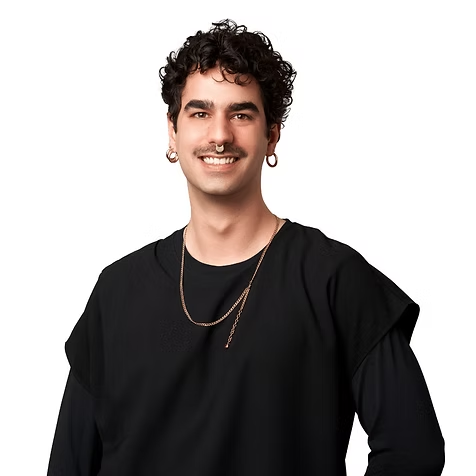
PurposeMed, the company that developed Freddie, was initially thought of as a way to connect folks to online health care during the pandemic. We’ve seen that the pandemic has really decreased folks’ ability to maintain regular contact with healthcare providers, and to access healthcare in the first place. It has really exacerbated a lot of the barriers that communities already face – [for example:] finding a healthcare provider, finding an inclusive healthcare provider, and finding a healthcare provider that knows about PrEP [and] sexual health, and is going to treat them like a human being.
The goal during the pandemic was to ensure that folks were not losing touchpoints with their healthcare providers, and with health at large, as they were really stuck in their homes. Virtual healthcare as an idea really came from that context. Then we expanded and tailored the approach, specifically when it comes to Freddie, to make sure that PrEP is something that folks have access to.
We know [that], unfortunately, a lot of doctors don’t know what PrEP is; a lot of doctors don’t really take a harm reduction approach. So when people are telling them, “I want more HIV prevention,” doctors are telling folks that they should stop having certain types of sex, which we know doesn’t work, and it has the opposite impacts of what we want when it comes to decreasing STI rates.
So [Freddie] came from that unfortunate mixing pot of folks not being inclusive towards queer and trans communities at large, the pandemic having exacerbated a lot of health access opportunities, and sexual health being a really stigmatized conversation.
Patients [are] the ones having to educate their own doctors about PrEP themselves. The goal is that Freddie would ease all of those [problems] in a simple, easy-to-use process that’s accessible, convenient, confidential and is providing an alternative to a system that often doesn’t meet the needs of queer and trans communities.
Freddie works provincially. Within different provinces, there are different ways to offer PrEP. We’re active in B.C., Alberta, Saskatchewan, Manitoba, and Ontario. We work primarily with PrEP distribution. We offer nurse practitioners and clinicians that are trained and experienced [in] talking to you about PrEP. We offer care coordinators that are going to work with you through insurance [coverage] and payment, especially in provinces where it isn’t as straightforward as [it] is here in Alberta.
We have a full team essentially geared towards facilitating the process as much as possible. Labs, for example. We really support our patients finding labs, attending labs, and making sure that the process is top-notch. We offer swabs to our patients. Through the refilling of their prescriptions, you can choose and ask for your own swabs, so you can self-swab and then give them to a lab to ensure we’re not missing any STIs. We take STIs in communication very seriously, so we’re always working with public health authorities. If there is an STI diagnosis, we make sure that folks are getting treated and connected to treatment.
That’s the medical part, [and there] are services outside of that. We really see that Freddie is only able to exist because of community advocacy. We know that it wasn’t governments, and it wasn’t hospitals, that were pushing the needle when it comes to HIV [issues such as] awareness, stigma, and funding. We are only able to do this work because of the tireless efforts of community-based organizations like yours [Outlink], SafeLink, HIV Edmonton, ACT in Toronto, and The 519, just to name a few that have been advocating for safer and better access to STI prevention in Canada.
A lot of work has to do with honoring the history of activism. [It] has to do with honoring what has allowed us to do this, which often is translated through sponsoring drag shows, working directly with community, paying queer and trans creators, making sure that we’re going to events, offering educational sessions, and tailoring those educational sessions to the communities that we are working with, so that we’re not just an ad on a screen. It’s important for us to support the work of the groups that allowed us to be at this point.
One of our biggest initiatives is to try to get folks to think about PrEP and [STI] prevention through sponsoring drag shows, being at Pride [events], and continuing to do a lot of public health awareness. When the Canadian government approved PrEP, and provincial governments slowly started to fund it, there were no education efforts for it. There was no campaign, [and] there were a lot of missed opportunities when it comes to teaching our communities in a fun and evidence-based way about PrEP. We try to take this as an opportunity to do some of the work ourselves through videos, presentations, and events to educate Canadian queer and trans communities about HIV prevention.
I love the arts. My queerness is really important to me, and so is my Brazilian [background]. I was born and raised in São Paulo, Brazil. I moved here when I was 17, and I never got to experience what it was to be an out person in Brazil, a queer Brazilian person.
I like to do my own art as well. I love to do digital illustrations [and] printing. I love to put my prints on clothes, and just be creative in different ways. Outside of that, I love being around the river. Biking, going to the river, getting some sun, and attending local drag shows are some of my favorite things to do.
Today, we’re facing such an increased and hateful rhetoric [against] queer and trans communities. We have seen an incredible amount of progress when it comes to representation and visibility. But at the same time, without protections, without aggressive support and allyship, that visibility can turn its head around and become weaponized.
There’s been an increased number of threats, negative messages, comments, and discourse in media and in-person that is targeting [2SLGBTQ+] communities. Within that, it’s specifically targeting trans, nonbinary, and gender-diverse folks. Within that specifically, folks that are racialized, Black, brown, and Indigenous [are targeted].
[It] makes it much more important for this work to be louder, and for this work to be more effective. Now is not the time to step back in fear of responses. It’s not the time to step back because of the level of negative input that we’re getting, it’s actually time to do the opposite. It’s time to step in stronger.The progresses we have achieved, and continue to achieve, [don’t last] forever. For example, in Ontario, there was a clinic called Connect-Clinic that offered gender-affirming care, hormone therapy, surgery referrals, and legal name changes support for folks in Ontario virtually. But because of Ontario’s billing codes changing, they were unable to offer those services and to bill for those services anymore. That made the clinic unsustainable, and unable to exist. [This] left 1500 patients that they had without care, and 2000 patients they had on their waitlist without care. We see that in that example in Ontario, a government decision about billing codes completely made it such that now so many trans, nonbinary, and gender-diverse folks are looking for and without gender-affirming care options.
[Note: Connect-Clinic closed in December 2022, after Ontario Health Insurance Plan (OHIP) fees for virtual-only medical services were lowered, but has since re-opened under the new name Foria Clinic. It is available to anyone in Ontario. Further reading on these developments can be found below.]
[We need to] understand [that] progress can be reversed, and that we need to continue supporting and offering accessible healthcare to those communities.Because every province has a different way of providing PrEP, for example, we have to work really closely with those provincial regulations. [This] has made [our] work possible and very widespread in certain provinces, and more limited in other provinces.
To me, advocacy means listening to communities. Advocacy means listening to the evidence we have, because the communities that are impacted by these decisions have a very strong understanding of what decisions need to be made. They have a very strong understanding of what improves and increases access. It’s standing with communities with evidence, and making sure that we are advocating within government levels and positions so that we can continue to make PrEP and HIV prevention accessible.
I always like to highlight that we work within a context of always wanting to support the value of community groups and partners, and [being] accountable to [them]. Partnerships and working together with those groups is really huge for us at Freddie.
One of the fun parts of doing this job is that we can challenge some of the constant narratives. [When it comes to] our images and branding, I’m very passionate about the fact that it’s our responsibility not to feed into old stereotypes, [as well as] negative and monolithic perceptions of queer bodies that we often see. Even within branding and image creation, it was very important for us to represent queer and trans communities as they are: feminine, masculine, hairy, hairless, fat, thin, whatever the case is. We still have a long way to go; don’t get me wrong, we still have to do a better job at that. But I would say it was one of the things that I really enjoyed, the ability to manifest what it is that we want to see when it comes to representation: real bodies and real people rather than toxic masculinity.
With Freddie, you can get PrEP delivered discreetly to your door for free. Their team of clinicians and pharmacists will provide affirming and evidence-driven care, without the judgment, and can help you access PrEP online. Visit Freddie’s website to start an assessment.
Further reading:
Winsa, Patty. “Gender-affirming clinic to privatize services after OHIP cuts: ‘There is an incredible dearth and lack of care for people who are trans’.” Toronto Star, 28 June 2023.
Winsa, Patty. “This gender-affirming clinic in Toronto closes today as lower virtual-health fees set in.” Toronto Star, 1 December 2022.